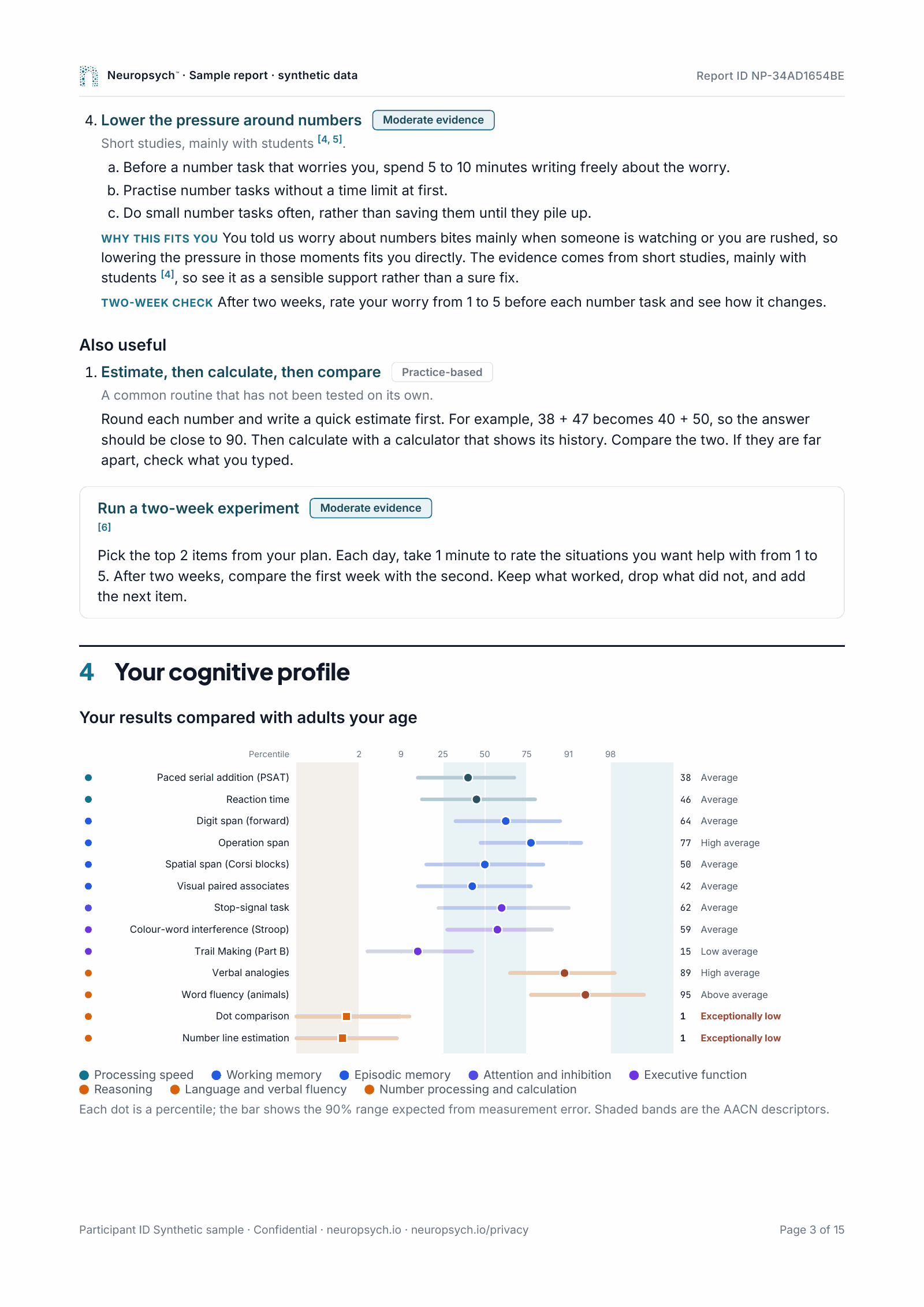
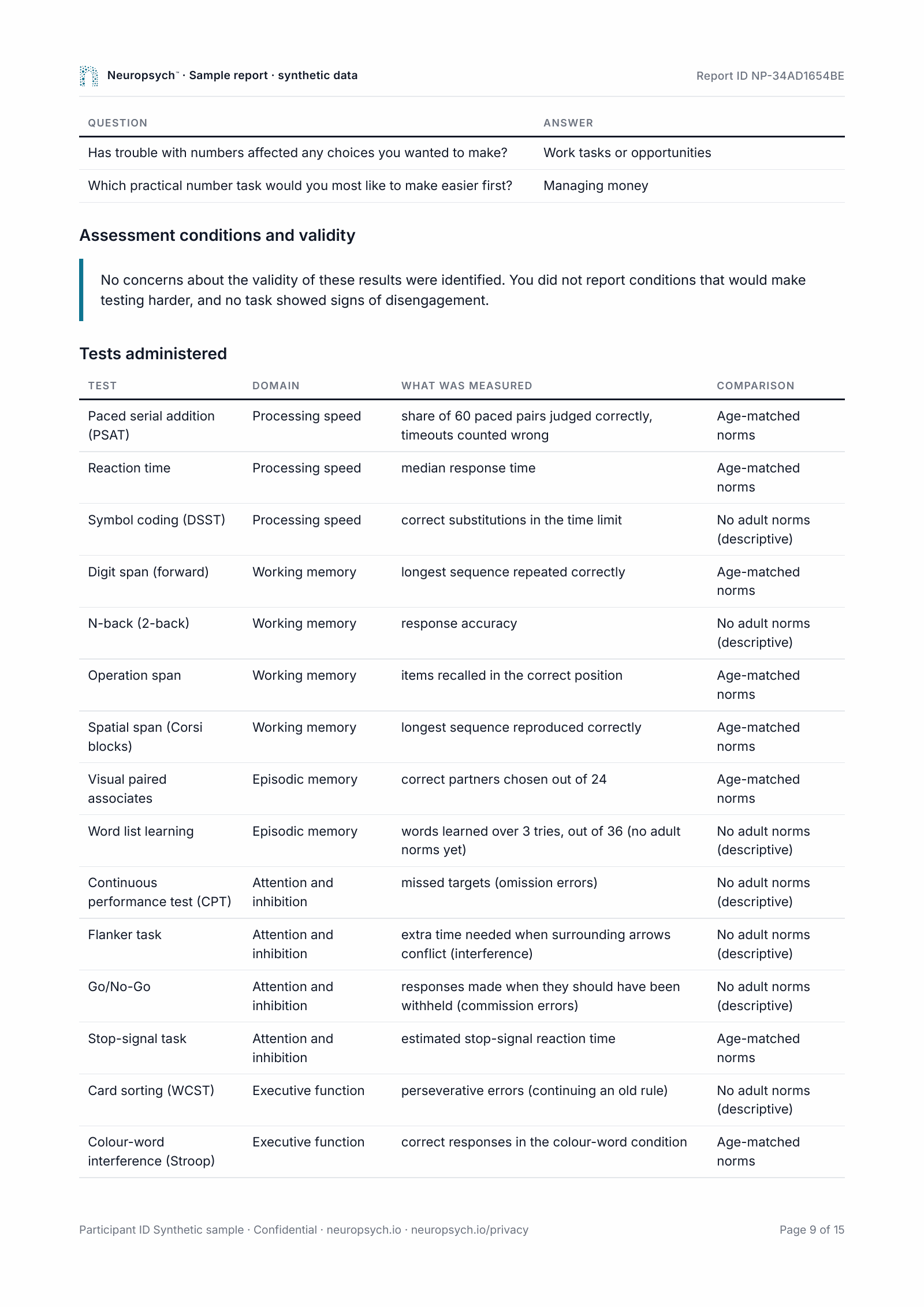
| Paced serial addition (PSAT) | Processing speed | share of 60 paced pairs judged correctly, timeouts counted wrong | Age-matched norms |
|---|
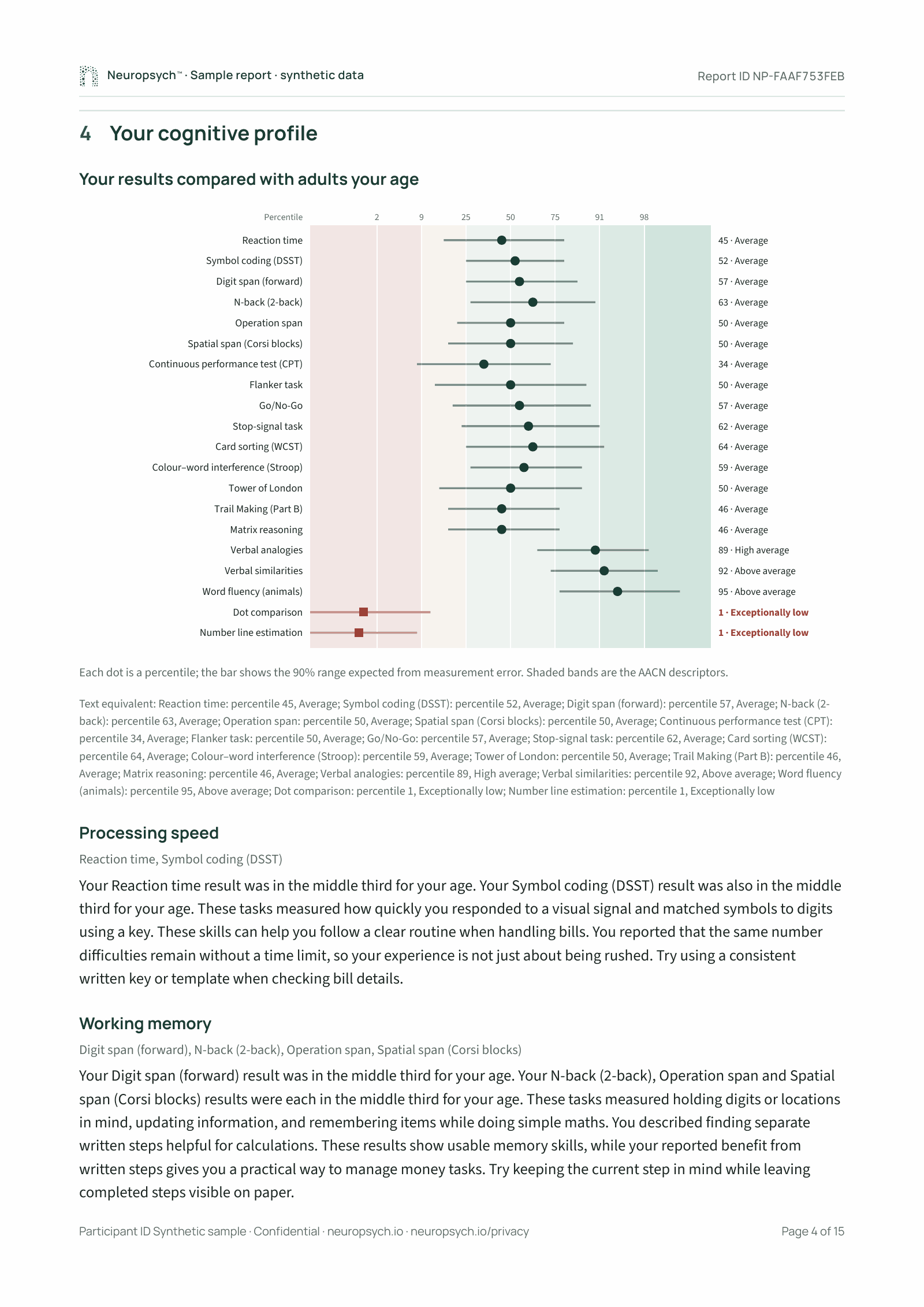
| Reaction time | Processing speed | median response time | Age-matched norms |
|---|
| Symbol coding (DSST) | Processing speed | correct substitutions in the time limit | No adult norms (descriptive) |
|---|
| Digit span (forward) | Working memory | longest sequence repeated correctly | Age-matched norms |
|---|
| N-back (2-back) | Working memory | response accuracy | No adult norms (descriptive) |
|---|
| Operation span | Working memory | items recalled in the correct position | Age-matched norms |
|---|
| Spatial span (Corsi blocks) | Working memory | longest sequence reproduced correctly | Age-matched norms |
|---|
| Visual paired associates | Episodic memory | correct partners chosen out of 24 | Age-matched norms |
|---|
| Word list learning | Episodic memory | words learned over 3 tries, out of 36 (no adult norms yet) | No adult norms (descriptive) |
|---|
| Continuous performance test (CPT) | Attention and inhibition | missed targets (omission errors) | No adult norms (descriptive) |
|---|
| Flanker task | Attention and inhibition | extra time needed when surrounding arrows conflict (interference) | No adult norms (descriptive) |
|---|
| Go/No-Go | Attention and inhibition | responses made when they should have been withheld (commission errors) | No adult norms (descriptive) |
|---|
| Stop-signal task | Attention and inhibition | estimated stop-signal reaction time | Age-matched norms |
|---|
| Card sorting (WCST) | Executive function | perseverative errors (continuing an old rule) | No adult norms (descriptive) |
|---|
| Colour-word interference (Stroop) | Executive function | correct responses in the colour-word condition | Age-matched norms |
|---|
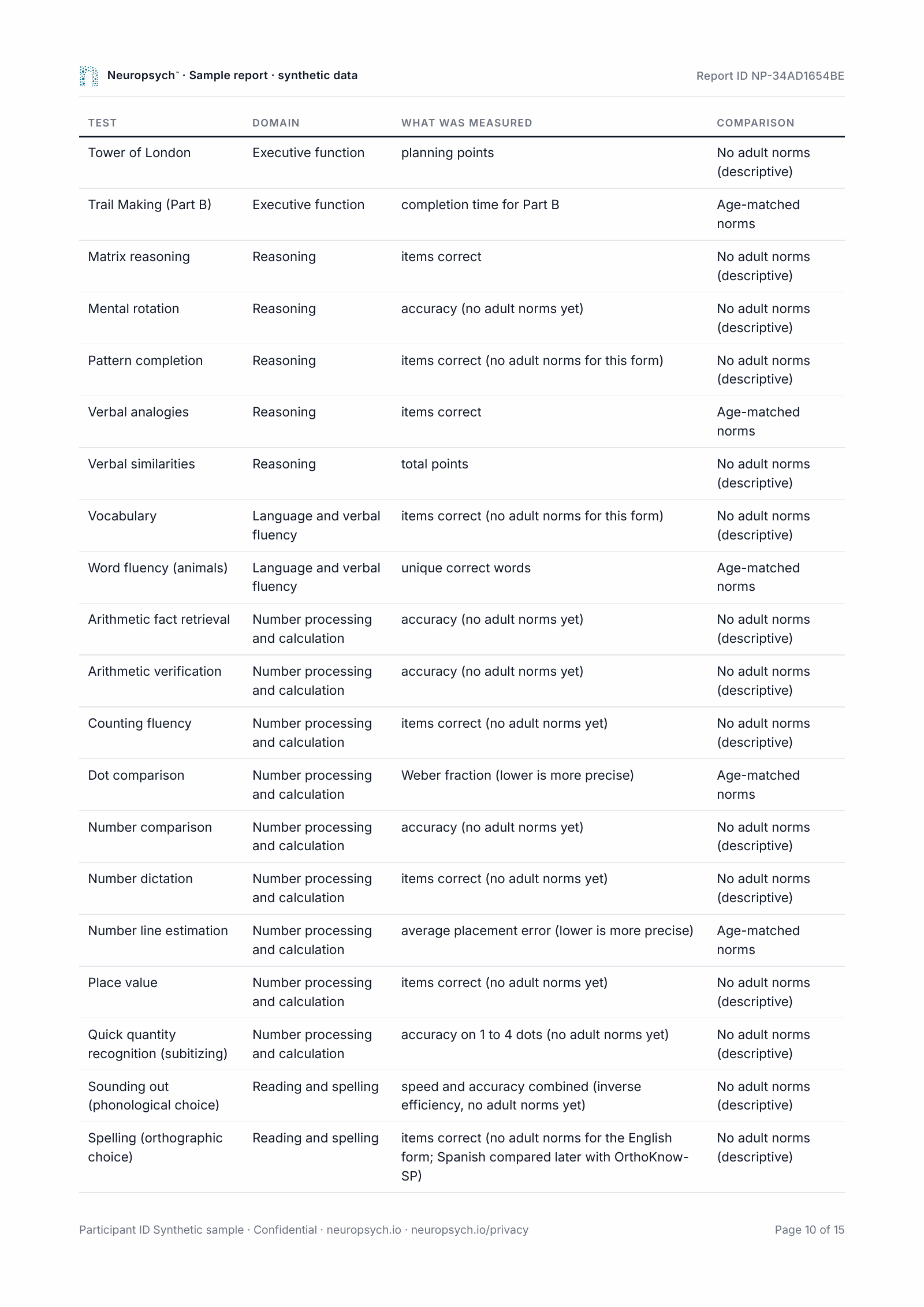
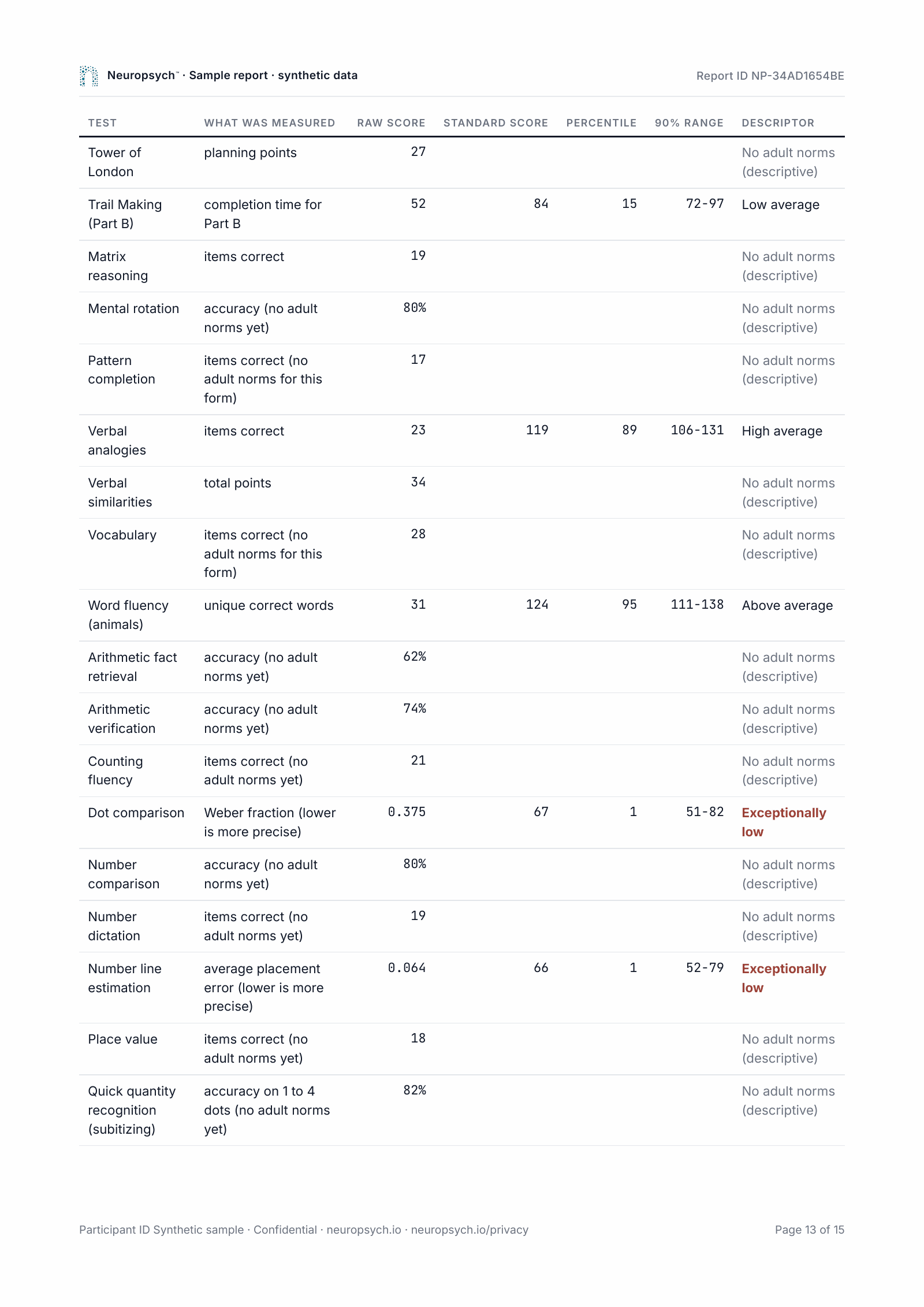
| Tower of London | Executive function | planning points | No adult norms (descriptive) |
|---|
| Trail Making (Part B) | Executive function | completion time for Part B | Age-matched norms |
|---|
| Matrix reasoning | Reasoning | items correct | No adult norms (descriptive) |
|---|
| Mental rotation | Reasoning | accuracy (no adult norms yet) | No adult norms (descriptive) |
|---|
| Pattern completion | Reasoning | items correct (no adult norms for this form) | No adult norms (descriptive) |
|---|
| Verbal analogies | Reasoning | items correct | Age-matched norms |
|---|
| Verbal similarities | Reasoning | total points | No adult norms (descriptive) |
|---|
| Vocabulary | Language and verbal fluency | items correct (no adult norms for this form) | No adult norms (descriptive) |
|---|
| Word fluency (animals) | Language and verbal fluency | unique correct words | Age-matched norms |
|---|
| Arithmetic fact retrieval | Number processing and calculation | accuracy (no adult norms yet) | No adult norms (descriptive) |
|---|
| Arithmetic verification | Number processing and calculation | accuracy (no adult norms yet) | No adult norms (descriptive) |
|---|
| Counting fluency | Number processing and calculation | items correct (no adult norms yet) | No adult norms (descriptive) |
|---|
| Dot comparison | Number processing and calculation | Weber fraction (lower is more precise) | Age-matched norms |
|---|
| Number comparison | Number processing and calculation | accuracy (no adult norms yet) | No adult norms (descriptive) |
|---|
| Number dictation | Number processing and calculation | items correct (no adult norms yet) | No adult norms (descriptive) |
|---|
| Number line estimation | Number processing and calculation | average placement error (lower is more precise) | Age-matched norms |
|---|
| Place value | Number processing and calculation | items correct (no adult norms yet) | No adult norms (descriptive) |
|---|
| Quick quantity recognition (subitizing) | Number processing and calculation | accuracy on 1 to 4 dots (no adult norms yet) | No adult norms (descriptive) |
|---|
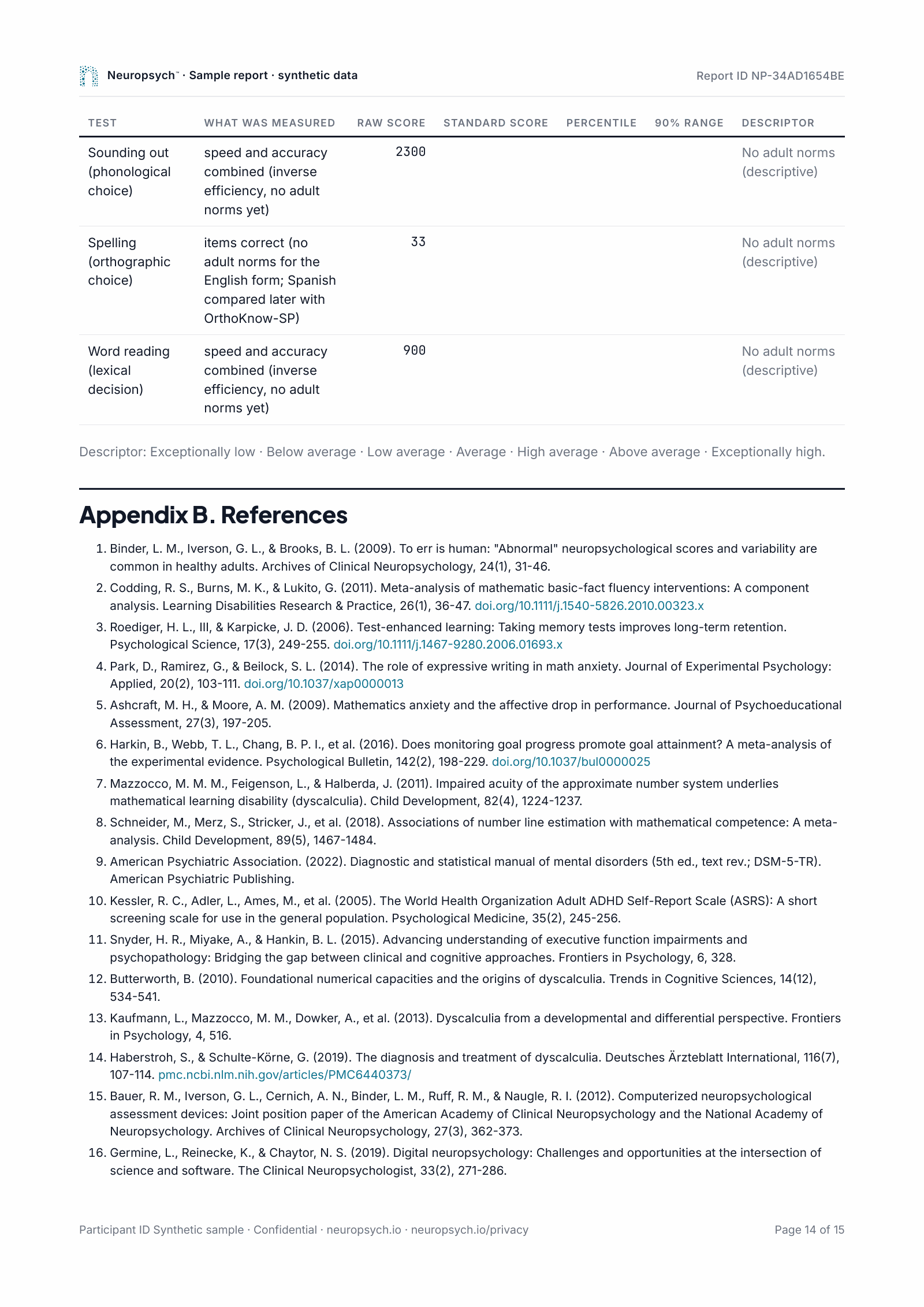
| Sounding out (phonological choice) | Reading and spelling | speed and accuracy combined (inverse efficiency, no adult norms yet) | No adult norms (descriptive) |
|---|
| Spelling (orthographic choice) | Reading and spelling | items correct (no adult norms for the English form; Spanish compared later with OrthoKnow-SP) | No adult norms (descriptive) |
|---|
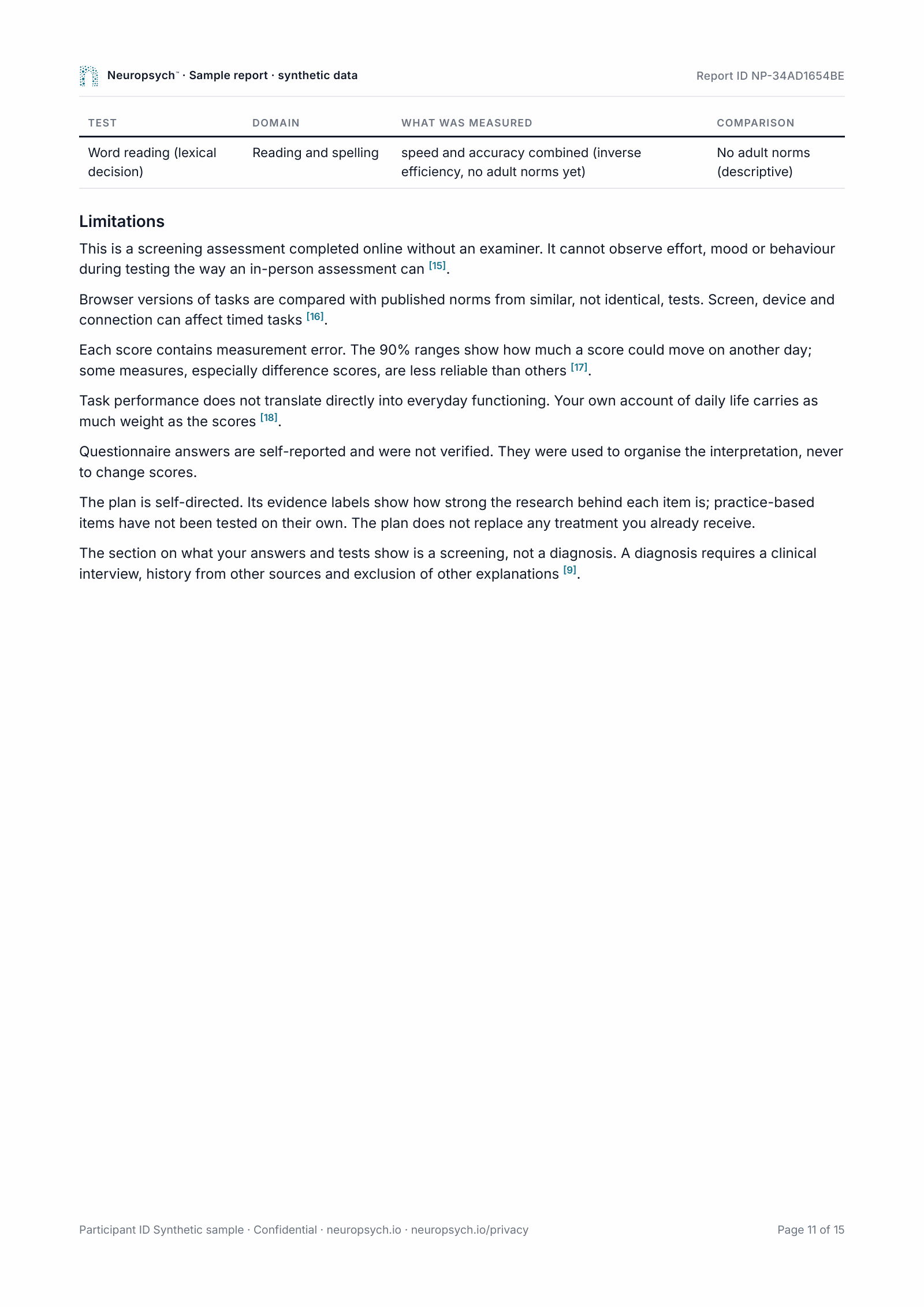
| Word reading (lexical decision) | Reading and spelling | speed and accuracy combined (inverse efficiency, no adult norms yet) | No adult norms (descriptive) |
|---|